
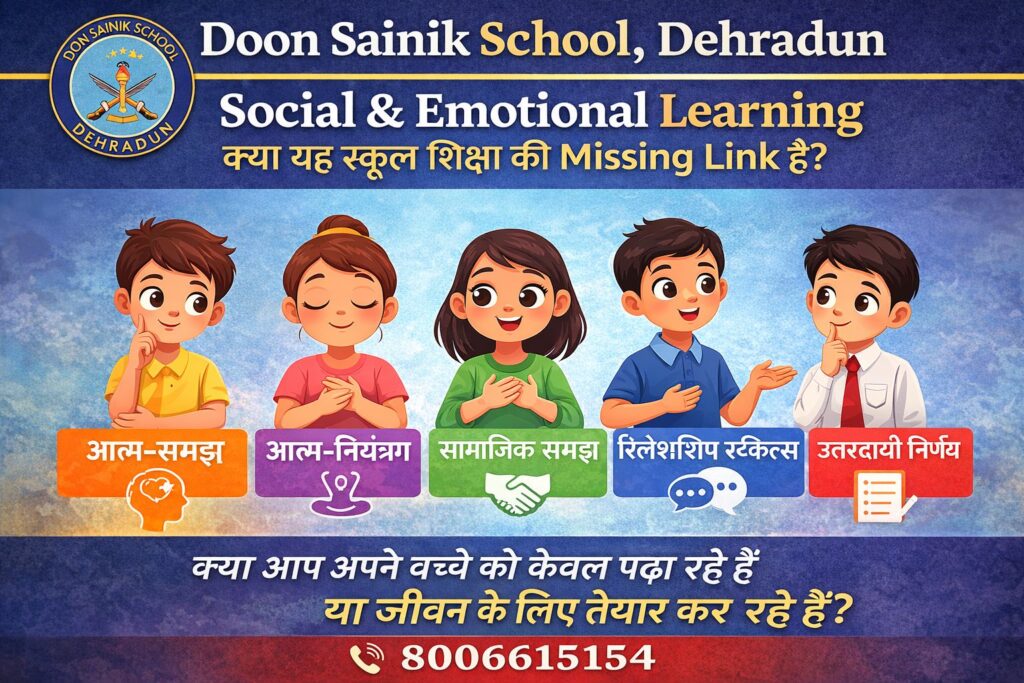
Social & Emotional Learning: Is It the Missing Link in School Education?
Today’s school education system has become more structured than ever before. The syllabus is fixed, exams are fixed, and competition is intense. But one important question keeps coming up again and again —
Are we only teaching children to study, or are we also preparing them for life? This is where the need and importance of Social & Emotional Learning (SEL) becomes clear. Many education experts believe that SEL is the biggest missing link in today’s school education system.
What Is Social & Emotional Learning (SEL)?
Social & Emotional Learning means developing those abilities in children that help them to:
- Understand their own emotions
- Control and manage their emotions
- Build healthy relationships with others
- Make the right decisions
- Learn how to handle stress, failure, and pressure
In simple words, SEL does not just help children become good students—it helps them become good human beings.
Where Is the Problem in Today’s Education System?
The current education system mainly focuses on three things:
- Marks
- Rank
- Competition
Children learn many things such as:
- Mathematics formulas
- Science concepts
- History dates
But often, they do not learn how to:
- Handle themselves after failure
- Deal with anger or fear
- Work as part of a team
- Show empathy towards others
As a result, problems like:
- Anxiety
- Low confidence
- Aggression
- Emotional imbalance are increasing among children.
Emotional Intelligence: The Most Important Skill of the Future
The world in which today’s children are growing up does not require only a high IQ. EQ (Emotional Quotient) is equally important.
Research shows that:
- Children with high EQ make better life decisions
- They perform better in leadership roles
- They handle stress and pressure more effectively
- Social & Emotional Learning helps develop this EQ in children.
The Five Core Components of SEL
Self-Awareness
Children learn to recognize their emotions, strengths, and weaknesses.
Self-Management
Learning how to handle stress, anger, fear, and disappointment.
Social Awareness
Understanding the emotions of others and developing empathy.
Relationship Skills
Healthy communication, teamwork, and conflict resolution.
Responsible Decision Making
Making thoughtful decisions and understanding their outcomes.
Why Is SEL Important in Schools?
- Better Academic Performance: Emotionally stable children are able to focus better on their studies.
- Discipline Develops Naturally: Discipline comes through understanding, not fear.
- Reduction in Bullying and Aggression: SEL teaches respect and empathy among children.
- Development of Leadership Skills: Confidence, communication, and responsibility increase.
- Strong Mental Health: Protection from problems like depression, anxiety, and burnout.
Also Read: Why Divya Mam’ Doon Sainik School is Best for RIMC Coaching?
The Role of Teachers: Not Just Instructors, but Mentors
Teachers play the most important role in making SEL successful.
Teachers need to:
- Understand the emotions of children
- Focus not just on mistakes, but on the reasons behind them
- Practice encouragement and good listening skills
When a teacher becomes a mentor, the classroom turns into a safe learning space.
The Role of Parents: SEL Begins at Home
SEL is not only the responsibility of schools. Parents play an equally important role.
Parents should:
- Listen carefully to their children
- Avoid scolding for every mistake
- Not suppress emotions
- Avoid comparisons
Only when home and school work together can a child’s emotional development truly happen.
Importance of SEL in Defence & Residential Schools
In defence-oriented schools, boarding schools, and residential academies, SEL becomes even more important because:
- Children stay away from home
- Discipline is strict
- Pressure and routines are intense
In such environments, qualities like:
- Emotional resilience
- Team bonding
- Leadership
- Self-discipline
are not possible without SEL.
That is why modern defence education considers SEL a core philosophy.
Does SEL Reduce Study Time?
This is a common misconception.
In reality:
- SEL does not interrupt studies; it supports them
- Emotionally strong children learn faster and more deeply
- Classroom disruptions reduce
SEL is not against academics—it is the foundation of effective learning.
India’s Education Policy and SEL
The National Education Policy (NEP 2020)[1] also emphasizes:
- Holistic development
- Life skills
- Value-based education
SEL is an important part of this holistic approach, and schools need to actively adopt it.
Conclusion: Is SEL Really the Missing Link?
The answer is clear — Yes.
As long as education:
- Remains limited only to marks
- Ignores emotions and values
We may create successful professionals, but not balanced, sensitive, and responsible citizens.
Social & Emotional Learning is the missing link that:
- Connects education with life
- Connects discipline with understanding
- Truly prepares children for the future
“The purpose of education is not only to provide knowledge, but to build human beings.”
Social & Emotional Learning fulfills this very purpose.
Find out more on YouTube
